How to Clean and Maintain a Pigeon Net So It Lasts Ten Years
A practical maintenance routine for balcony bird nets — safe cleaning method, tension checks, repair versus replacement, and the annual schedule that doubles net life.
By Perfect Bird Netting Service ·
A virgin UV HDPE net is rated for eight to ten years. Most of the nets we replace early did not wear out — they were pulled apart by debris load, or they lost tension after one storm and nobody checked. Twenty minutes twice a year is the whole maintenance programme.
What actually degrades a bird net
| Cause | Effect | Preventable? |
|---|---|---|
| Leaf and debris load at the bottom edge | Hook pull-out, sagging | Yes — clear twice a year |
| Lost wire tension after a storm | Scalloped edges, wind flap | Yes — annual tension check |
| Dust build-up in fine mesh | Wind load increases | Yes — rinse |
| UV exposure | Slow embrittlement | Only by specifying virgin UV grade |
| Dried droppings on the mesh | Health risk, weight, staining | Yes — wet-clean |
The safe cleaning method
Never dry-brush a net that carries dried droppings. Aerosolised faecal dust carries histoplasmosis and cryptococcosis spores; the US CDC advice is to wet the material before any disturbance. The reasons are explained fully in why pigeon droppings are a real health hazard.
Step by step
- Wear an N95 mask and gloves; keep children and pets indoors.
- Mist the net with water until visibly damp — do not blast it with a pressure washer, which tears mesh and loosens lacing.
- Wipe or gently rinse with plain water or a mild detergent solution; avoid bleach and solvents, which attack polymers.
- Clear leaves and debris trapped at the bottom edge and in corners.
- Bag the waste and disinfect the parapet and floor.
- Let the net dry fully before checking tension.
Wet it before you touch it. That single habit removes most of the health risk from net cleaning.
The annual tension check
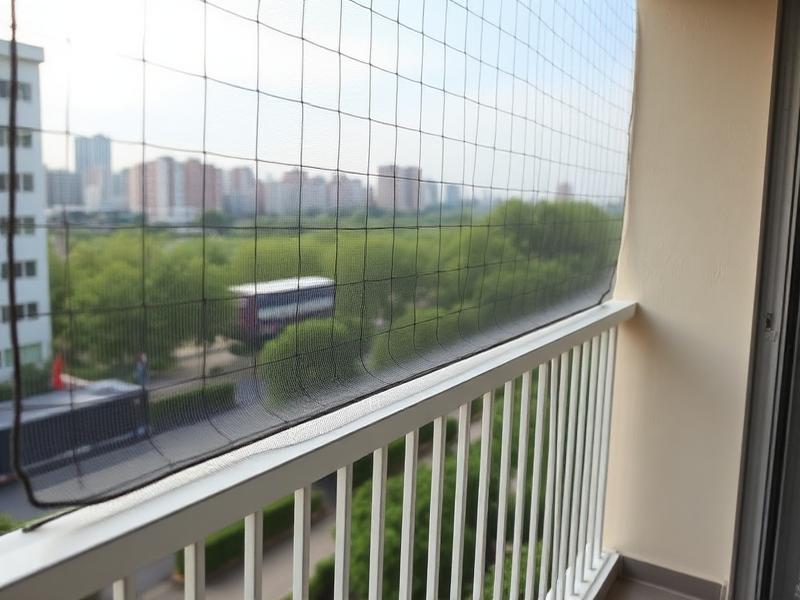
After the first heavy storm of the monsoon, run your hand along the perimeter wire. It should be tight enough to hum when tapped and the mesh should be square with no scalloping between hooks. Look specifically at:
- Corner hooks — always the highest-stress points.
- Any hook that has migrated outward from its hole.
- Lacing cord that has snapped, leaving a section of mesh loose on the wire.
- The bottom edge closure against the parapet.
- Rust bleed from a hook or wire, which means galvanised hardware was used instead of SS 304.
Re-tensioning a slightly slack net is a fifteen-minute job. Ignoring it for a season turns it into a re-installation. Seasonal specifics are in monsoon maintenance for bird nets.
Repair or replace?
| Condition | Action | Typical cost |
|---|---|---|
| Small tear under 6 inches | Patch and re-lace | Nominal / under warranty |
| Slack wire, mesh sound | Re-tension | Nominal |
| Two or three pulled hooks | Re-anchor locally | Small charge |
| Mesh brittle, snaps when flexed | Replace the panel | Full sq ft rate |
| Rust staining across the facade | Replace hardware with SS 304 | Hardware + labour |
A quick field test for embrittlement: pinch a strand and flex it. Healthy HDPE bends and springs back; a net at end of life crackles and breaks. If it breaks, patching is wasted money — see pigeon net price per square feet for replacement costs.
The maintenance calendar
| When | Task |
|---|---|
| Pre-monsoon (May–June) | Rinse, clear debris, check tension and hooks |
| After first major storm | Tension check, look for scalloping |
| Post-monsoon (Oct) | Rinse off dust and algae, clear the bottom edge |
| Every 3 years | Flex test a strand for embrittlement |
| Year 8–10 | Plan replacement of virgin HDPE panels |
What voids most warranties
- Pressure washing the mesh.
- Bleach, thinner or solvent-based cleaners.
- Hanging plants, clothes lines or lights from the net or its wire.
- Cutting an access hole instead of asking for a laced service flap.
- Third-party re-anchoring with non-stainless hardware.
The last one matters most. Mixed metals at a fixing point corrode faster than either metal alone, and that is where a net fails.
Conclusion
Bird nets do not need much, but they do need something. Wet-clean twice a year, check the tension after the first storm, keep the bottom edge clear, and never hang anything from the wire. Do that and a virgin UV HDPE net will comfortably reach its tenth year.
We service and re-tension nets we did not install, and our own installations carry a written warranty. Get in touch or read our materials and process.
Frequently asked
How do I clean a balcony pigeon net safely?
Wear an N95 mask and gloves, mist the net with water first so dried droppings cannot become airborne, then wipe or gently rinse with plain water or a mild detergent. Never dry-brush and never pressure wash.
How often should a bird net be maintained?
Twice a year — a pre-monsoon clean and tension check, and a post-monsoon rinse — plus a tension check after the first heavy storm of the season.
Can a torn pigeon net be repaired?
Yes. Tears under about six inches are patched and re-laced, and pulled hooks are re-anchored locally. Replacement is only needed once the mesh has become brittle and snaps when flexed.
Does pressure washing damage a bird net?
Yes. High pressure tears the mesh, breaks lacing cord and can pull hooks. Misting and gentle rinsing is the correct method.
Our services in Indore
Every installation below is fitted by our own Indore crew, with a free site inspection and written warranty.
Get a free site inspection
Share a photo of your opening and we'll send a written per-sq-ft quote the same day.
Chat on WhatsApp